Q-Bot: Cavity Wall Inspection Robot
Robot design and build
- ROS
- Confined Spaces
- BLDC
- Teleoperation
- 3D Printing
- Surveying
TL;DR
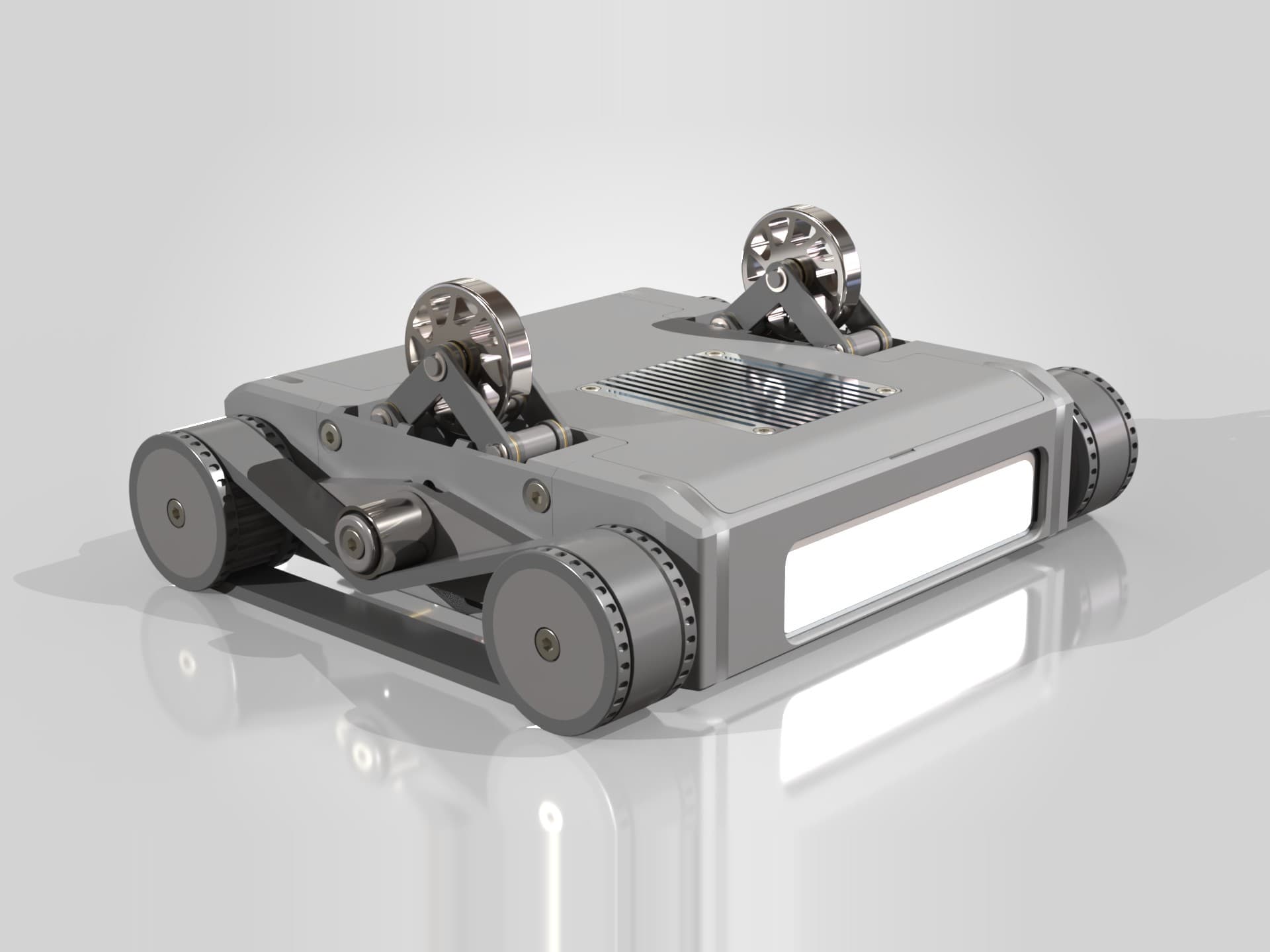
Lianabot is a small, wirelessly controlled surveying robot built to go where no person and almost no machine can: the inside of a cavity wall. It climbs the void between the two leaves of the wall to survey insulation condition, checking whether insulation has deteriorated or was installed correctly in the first place, and it works in cavities as narrow as 50 mm. It was built for both practical inspection and research use.
How it climbs
A cavity wall gives you nothing to drive on, so Lianabot braces against the walls themselves: two spring-loaded wheels on scissor linkages protrude from the top of the robot and press against the opposite face of the cavity, generating the traction that a belt drive system then pushes against. The result is a robot that holds itself in the void by preload and climbs on demand. In testing it proved extremely manoeuvrable, with no significant mobility issues across the voids and cavities it was run in.
Control and sensing
The robot runs ROS, and the operator drives it from a handheld gaming PC with a built-in screen and joystick controls: live video streaming from the onboard camera, with real-time position tracking provided by a simultaneous localisation camera. The operator always knows what the robot sees and where it is inside the wall, which is the entire value of a survey tool.
Hardware
Onboard: a Raspberry Pi, camera, two Dynamixel BLDC motors, a wireless antenna, and four 18650 cells giving roughly 30 minutes of runtime at a wireless range of about 40 metres. The outer casing is fully 3D printed, with precision-machined structural parts where the loads demand it, such as the motor-to-wheel connecting shafts.